
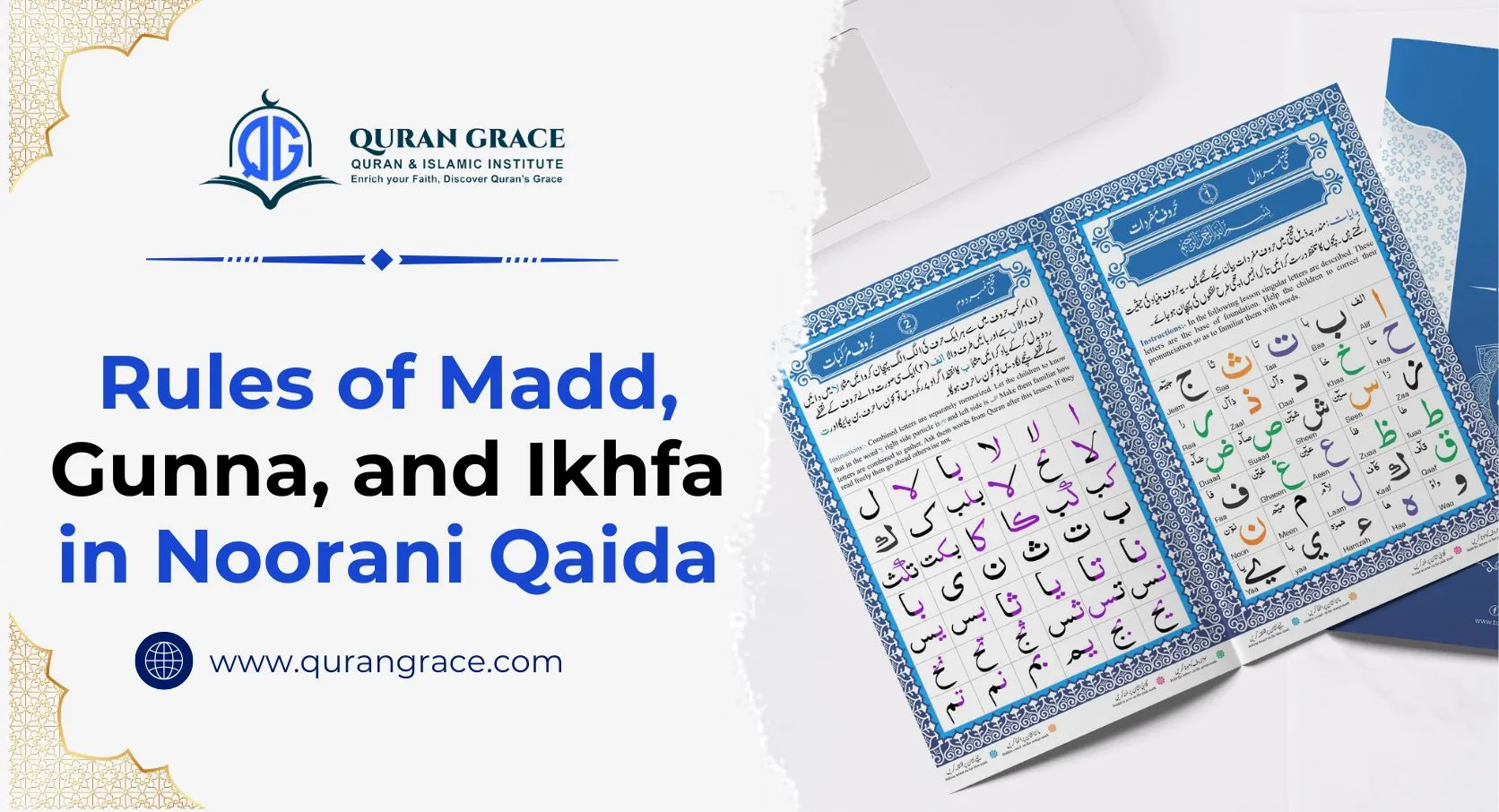
Proper Quranic recitation is not merely about pronouncing letters; it is about giving every letter its due right according to the rules of Tajweed. For students at Quran Grace, mastering the Noorani Qaida course is the first step toward this goal. Among the most essential rules that beautify recitation and preserve the meaning of the verses are Madd (Prolongation), Ghunna (Nasalization), and Ikhfa (Hiding).
These rules govern how we stretch sounds, how we utilize the nasal cavity, and how we blend letters. Mastering them transforms a basic recitation into one that is rhythmic, melodious, and linguistically accurate.
Madd, Ghunna, and Ikhfa Rules in Noorani Qaida
1. The Rule of Madd (The Art of Prolongation)
Madd is the stretching of a vowel sound. While the Noorani Qaida introduces basic stretching, advanced Tajweed categorizes Madd into various lengths measured by “Harakaat” (finger motions or beats).
- The Letters of Madd (Huroof al-Madd):
- Alif (ا): When it is silent and preceded by a Fatha (e.g., بَا).
- Waw (و): When it is silent and preceded by a Damma (e.g., بُو).
- Ya (ي): When it is silent and preceded by a Kasra (e.g., بِي).
- The Mechanics: There is the Madd Asli (Original Madd), which is always 2 beats. However, if a Hamza (ء) or a Sukun (ـْ) follows a Madd letter, it becomes Madd Far’ee (Derived Madd), which can be stretched to 4, 5, or 6 beats.
Quranic Examples:
- Madd Asli (2 beats): نُوحِيهَا (Noo-hee-haa) — This word contains all three Madd letters, each stretched for exactly two beats.
- Madd Muttasil (4-5 beats): السَّمَاء (As-Samaaa’) — Here, the Alif is followed by a Hamza in the same word, requiring a longer stretch.
- Madd Lazim (6 beats): الضَّالِّينَ (Ad-Daallieen) — When a Madd letter is followed by a Mushaddad letter (with a Shaddah), it must be stretched to its maximum length of 6 beats.
2. The Rule of Ghunna (The Nasal Resonance)
Ghunna is often described as a “humming” sound produced through the nose. It is a vibration that stays in the nasal cavity (Al-Khayshum) and does not involve the tongue.
- The Primary Rule: Ghunna is mandatory and most powerful on two specific letters when they have a Shaddah (ّ):
- Noon Mushaddadah (نّ)
- Meem Mushaddadah (مّ)
- The Timing: The duration of the Ghunna is consistently 2 beats. You must hold the sound in the nose before releasing the vowel. A common mistake is rushing through these letters, which strips the recitation of its rhythmic beauty.
Quranic Examples:
- Noon with Shaddah: مِنَ الْجِنَّةِ وَالنَّاسِ (Minal Jinnati wan-Naas) — Both words require a distinct 2-beat nasal hold on the ‘N’ sound.
- Meem with Shaddah: فِي أُمِّهَا (Fee Ummihaa) — The ‘M’ sound is held firmly in the nose.
- Ghunna in Idgham: مَن يَقُولُ (May-yaqoolu) — While this is an Idgham rule, a Ghunna is produced as the Noon merges into the Ya.
3. The Rule of Ikhfa (The Nuanced “Hiding”)
Ikhfa is perhaps the most sophisticated rule in the Noorani Qaida. It occurs when a Noon Sakinah (نْ) or Tanween (ً ٍ ٌ) is followed by any of the 15 Ikhfa letters.
- The 15 Letters: ت ث ج د ذ ز س ش ص ض ط ظ ف ق ك
- The Mechanics: Instead of letting the tip of the tongue touch the roof of the mouth (as you would for a normal ‘N’), you keep the tongue suspended near the articulation point of the next letter.
- The Sound: You produce a 2-beat nasal sound. If the next letter is heavy (like Sad or Qaf), the Ikhfa sound is thick and heavy. If the next letter is light (like Ta or Seen), the Ikhfa sound is thin and light.
Quranic Examples:
- Light Ikhfa: مِن تَحْتِهَا (Min tahtihaa) — The ‘N’ is hidden with a light nasal sound because ‘Ta’ is a light letter.
- Heavy Ikhfa: مَن صَلَحَ (Man salaha) — The nasal sound becomes thick and heavy to prepare the mouth for the heavy ‘Sad’ letter.
- Ikhfa with Tanween: سَمِيعٌ قَرِيبٌ (Samee’un Qareeb) — The ‘N’ sound at the end of ‘Samee’un’ is hidden because it is followed by the letter ‘Qaf’.
Conclusion
Mastering these rules is what separates a beginner from a “Qari” (reciter). Madd gives the Quran its breath and length, Ghunna provides its soul and resonance, and Ikhfa adds a layer of delicate precision.
At Quran Grace, we don’t just teach you to memorize these rules; we train your ear to hear them and your tongue to perform them naturally. Through our personalized online sessions and structured noorani qaida course for kids, students can practice these intricate details until their recitation flows with the beauty and accuracy it deserves.