
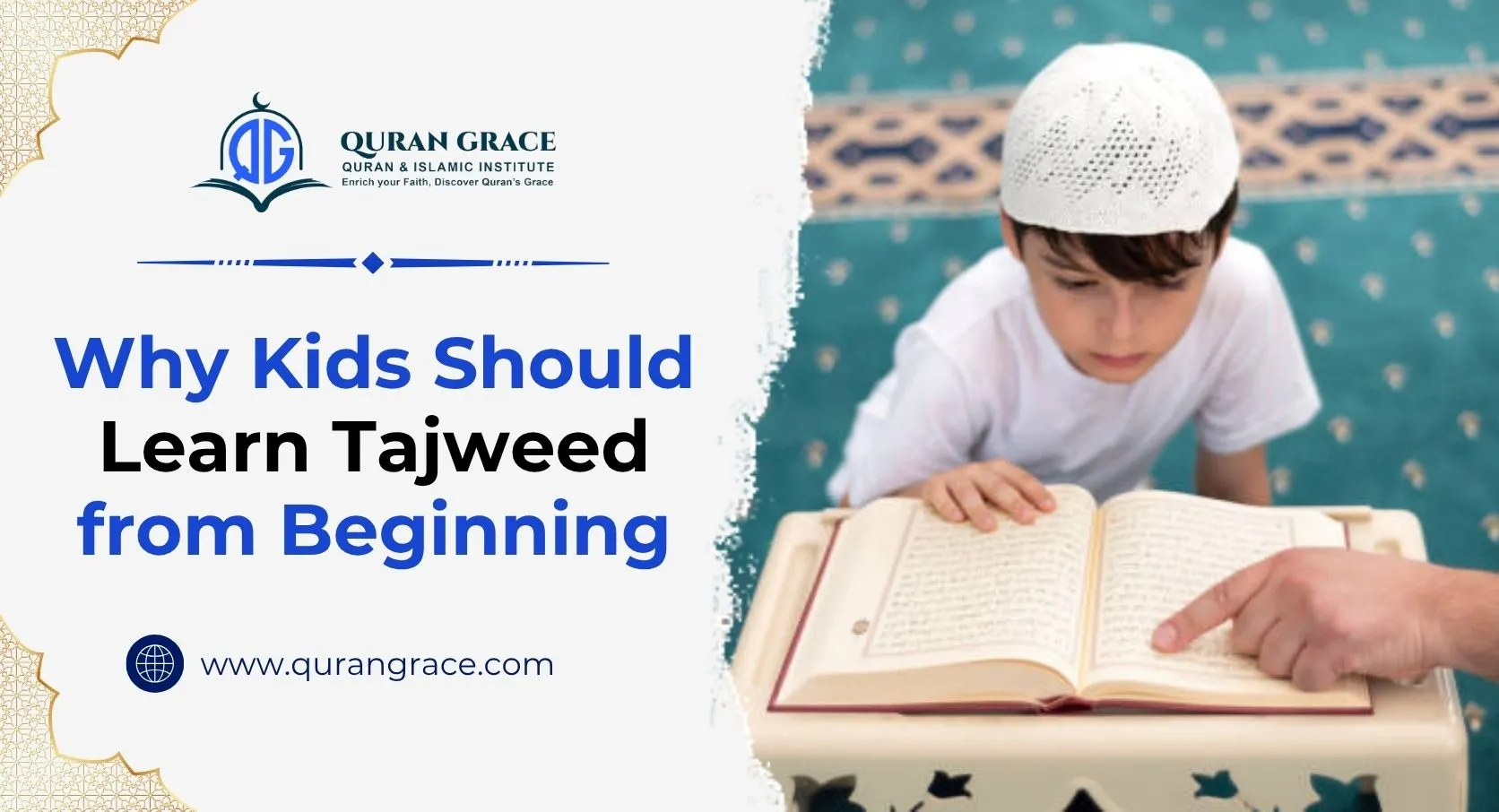
Tajweed is essential for accurate Quran reading and fostering a pure connection with Allah SWT. As parents, we should strive to teach Tajweed to our children from the very beginning so they can easily and naturally learn the proper pronunciation. There are many reasons why kids need to learn Tajweed from the outset. Let’s explore the connections between accuracy, discipline, confidence, and much more.
10 Reasons Why Kids Should Learn Tajweed From the Beginning
1. Flexible Articulation (Makharij)
The human speech mechanism is most flexible during childhood. Certain Arabic letters, such as the deep ‘ayn and the heavy qaaf, require specific muscle movements that are not found in English. Children can naturally master these “articulation points,” while adults often struggle due to their established speech habits.
In this regard, Quran Grace offers exclusive online Tajweed classes for Kids where they can practice the letters with proper pronunciation and apply all the relevant rules of the Tajweed.
2. Preventing unlearning wrong sounds
It is significantly harder to unlearn a mistake than it is to learn it correctly the first time. If a child spends years reciting without Tajweed, those errors become ingrained. Starting early ensures they never have to go through the frustrating process of correcting deep-seated mispronunciations.
3. Easy Language Acquisition
Research indicates that children’s brains are inherently designed for language acquisition. They display a remarkable phonetic sensitivity that enables them to effortlessly grasp the intricate rules of Ghunnah (nasalization) and Madd (stretching) in speech. This ability allows them to learn these linguistic features with the same ease as they acquire their native language.
4. Preserving the Meaning of the Quran
Arabic is known for its precision, where even slight variations in vowel length or letter weight can alter the meaning of a word significantly. Teaching children Tajweed from the beginning helps them appreciate and maintain the integrity of the text. This practice ensures that they respect and convey the intended message of Allah accurately, avoiding any accidental misinterpretation.
5. Building Confidence
Children who grasp the rules of language are empowered to move beyond guesswork. By understanding the “why” behind sounds, they cultivate a strong sense of mastery over their skills. This boost in confidence not only encourages them to recite aloud but also enables them to participate in prayers with greater assurance, allowing them to express themselves without the anxiety of making errors.
6. Developing Cognitive Discipline
Tajweed is an academic field that demands focus and keen attention to detail. By mastering its principles, children can enhance their cognitive skills, which, in turn, boosts their ability to concentrate and follow complex instructions. Learning these rules not only sharpens their minds but also fosters better discipline and understanding.
7. Creating a Spiritual Connection
The Quran was revealed to be recited in a specific, melodious way. When a child learns to apply Tajweed, their recitation becomes more rhythmic and beautiful. This beauty touches their heart, fostering a deep, emotional love for the Word of Allah.
8. Enhancing Memory (Hifz)
There is a strong link between Tajweed and memorization. The rhythmic patterns created by Tajweed rules act as a “mental hook,” making it much easier for children to memorize Surahs and retain them long-term.
9. Success in Public Recitation
Whether it is at school, in the Masjid, or during family gatherings, a child who recites with proper Tajweed stands out. This positive reinforcement from the community encourages them to stay connected to the Quran as they grow.
10. Fulfilling a Religious Duty
Reciting the Quran with Tajweed is essential, as it reflects the authentic method through which the Prophet (PBUH) received and transmitted the Quran. Introducing Tajweed to children early on fosters a sense of Ihsan (excellence) in their acts of worship, instilling a deep appreciation for the Quran and its proper recitation from a young age. This foundational skill not only enhances their understanding of the text but also enriches their spiritual experience.
Conclusion
Teaching Tajweed to children is not about placing a burden on them; it is about giving them the tools to succeed. By starting from the very first Alif, we ensure that their foundation is solid, their tongue is eloquent, and their hearts are connected to the majesty of the Quran.
At Quran Grace, we believe that every child has the potential to recite like a Qari. By enrolling in an online quran tajweed course, you can provide flexible, expert-guided learning that fits seamlessly into your child’s routine. By investing in their Tajweed today, you are giving them a skill that will beautify their prayers and guide their lives for decades to come.