
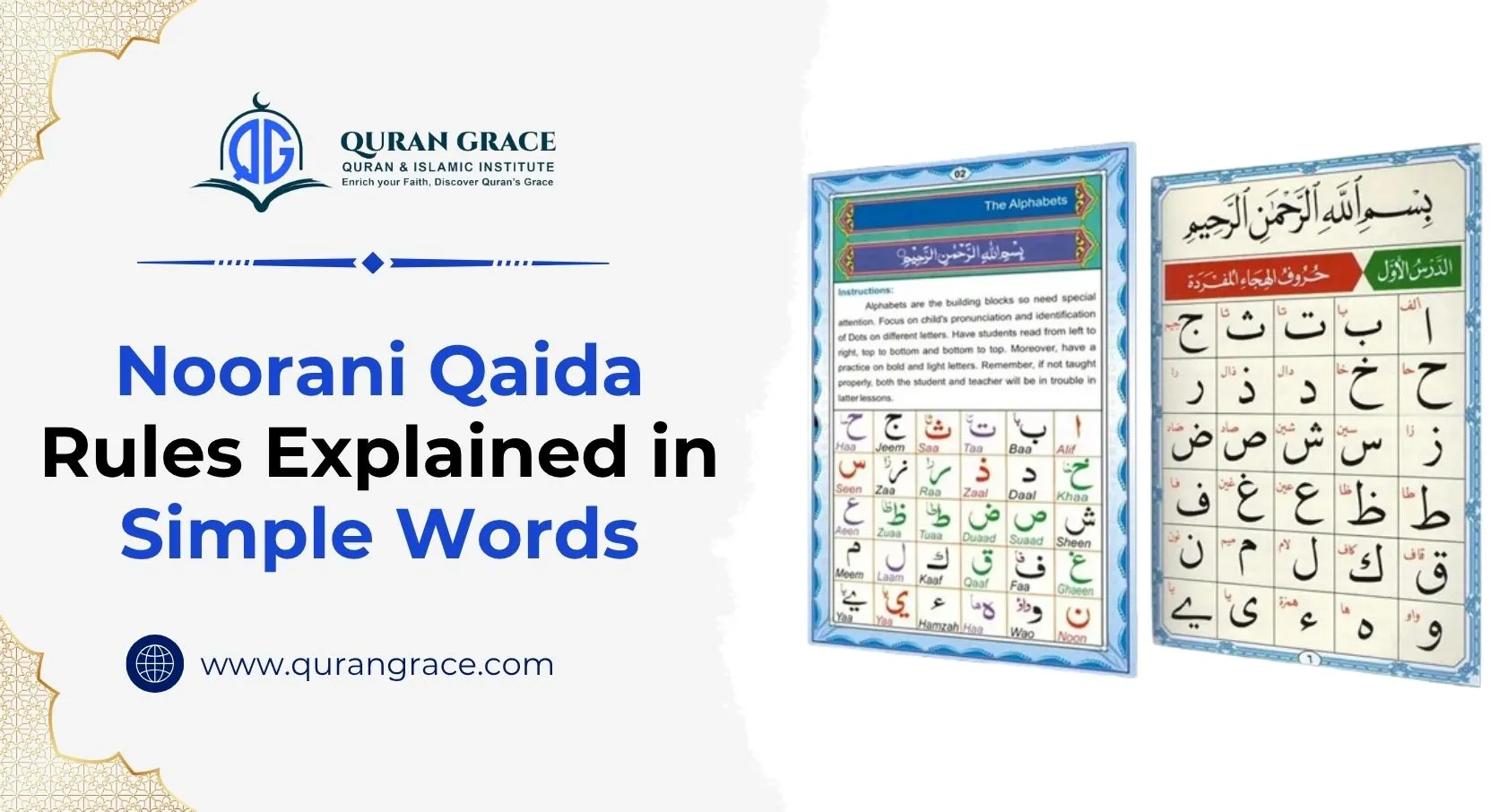
For many embarking on the beautiful journey of reciting the Quran, Noorani Qaida serves as the foundational stepping stone. It’s more than just a book; it’s a key that unlocks the door to proper Quranic recitation, ensuring every word is spoken with the respect and accuracy it deserves.
Learning Tajweed can often feel intimidating, especially for beginners who may find the technical terms and intricate rules overwhelming. However, the Noorani Qaida is specifically designed to simplify this process by breaking down these concepts into manageable lessons. In this blog, we will clear away the complex jargon and explain the core rules of Noorani Qaida in straightforward, easy-to-understand language, helping you on your journey to mastering Quranic recitation.
Table of Contents
ToggleThe Foundations of Noorani Qaida: A Simplified Guide
Think of Noorani Qaida as the alphabet book for learning to read the Quran with Tajweed. It starts with the very basics and gradually builds upon them, ensuring a strong foundation before moving on to more complex concepts. Here’s a breakdown of the key rules you’ll encounter, explained in plain English:
1. The Alphabet and Pronunciation (Makhraj)
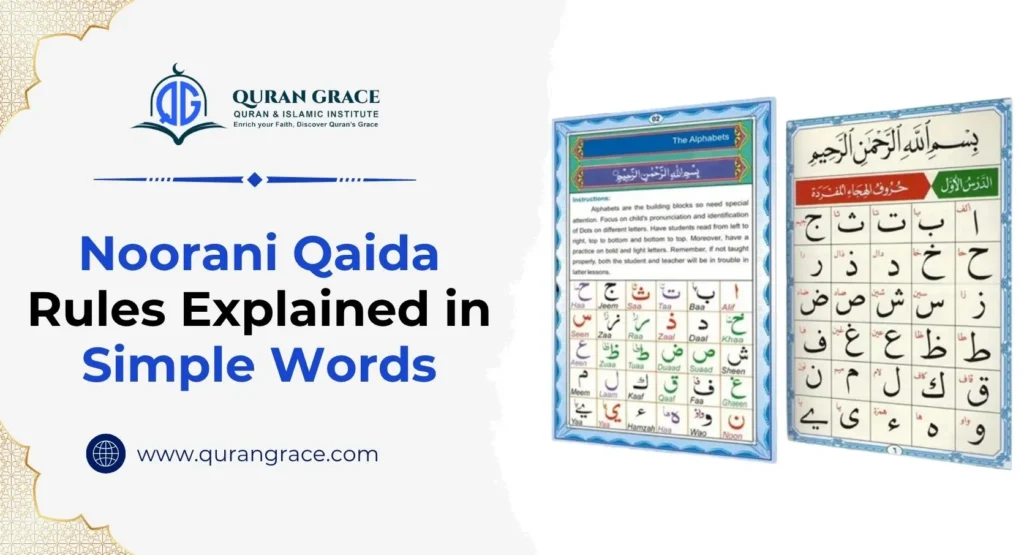
This is where it all begins. Noorani Qaida introduces you to the Arabic alphabet (Huroof-e-Tahajji), but more importantly, it teaches you how to pronounce each letter correctly. This isn’t just about making the sound; it’s about identifying the specific point of origin in the mouth or throat (known as Makhraj). You’ll learn to distinguish between similar-sounding letters (like ‘Saa’ and ‘Seen’, or ‘Ha’ and ‘Haa’) by understanding where the tongue, teeth, or throat should be placed. This foundational step is crucial for accurate recitation.
2. Vowels (Harakat)
Arabic letters on their own are like consonants without sounds. Vowels, or Harakat, provide the necessary vocalization. There are three short vowels: Fathah (a short ‘a ’ sound), Kasrah (a short ‘i ’ sound), and Dammah (a short ‘u’ sound). You’ll learn how these small symbols, placed above or below the letters, completely change their pronunciation. Noorani Qaida gives you ample practice to recognize and pronounce letters with these short vowels fluently.
3. Long Vowels (Huroof-e-Maddah)
In addition to short vowels, some letters elongate the sound of the preceding vowel. These are Alif, Waw, and Ya. You’ll learn the specific conditions under which these letters act as long vowels and practice holding the sound for the correct duration (usually two harakats). Mastering this is essential for conveying the intended meaning of the Quranic verses.
4. Tanween (Double Vowels)
Tanween represents double vowels (two Fathahs, two Kasrahs, or two Dammahs) found at the end of nouns. They produce a nasal sound, like a ‘nun’ sound added to the vowel. Noorani Qaida explains how to pronounce Tanween in different contexts, laying the groundwork for more advanced Tajweed rules, such as Ghunnah (nasalization).
5. Sukoon (Zero Vowel)
A letter with a Sukoon (a small circle or semi-circle above it) indicates that the letter should be pronounced without any vowel sound – a consonant-only sound. This is a crucial concept because many Tajweed rules are applied specifically to letters with Sukoon. For example, rules like Qalqalah (bouncing sound) apply only when certain letters carry a Sukoon.
6. Tashdeed (Shaddah)
Tashdeed (a small ‘w’ shape above a letter) signifies that the letter should be pronounced with double emphasis, almost like two separate instances of the same letter combined. It requires a brief pause and a stronger pronunciation. Noorani Qaida helps you master the correct pronunciation of letters with Tashdeed, ensuring you give them the proper weight they deserve.
7. Rules of Ghunnah (Nasalization)
Ghunnah refers to the nasal sound produced from the nose, primarily when pronouncing the letters ‘Noon’ (ن) and ‘Meem’ (م) under certain conditions. While basic Ghunnah is taught in Noorani Qaida, more complex rules regarding its application are introduced gradually. You’ll learn when to apply Ghunnah, especially with Noon Saakin and Tanween.
8. Basic Rules of Madd (Prolongation)
While the comprehensive Madd rules are advanced in Tajweed, the Noorani Qaida introduces the concept of extending vowel sounds beyond their basic length. You’ll learn to recognize signs that indicate a longer prolongation, adding depth and rhythm to your recitation.
Your Personalized Noorani Qaida Course
If you want to master the foundational rules of recitation in a supportive environment, consider enrolling in our online Noorani Qaida classes. Our qualified tutors provide personalized guidance and real-time feedback, helping you understand and apply the rules effectively. This course will boost your confidence and deepen your connection with the Holy Quran. Don’t hesitate—start your learning journey today!
Conclusion
Noorani Qaida may seem like a simple primer, but its importance cannot be overstated. It provides the essential building blocks for reciting the Holy Quran correctly and with devotion. By simplifying the core rules of pronunciation, vowels, prolongation, and other fundamental aspects of Tajweed, it empowers beginners to approach Quranic recitation with confidence and reverence.