

Tajweed refers to the rules governing the correct pronunciation of the letters and words in the Quran, enabling recitation that closely follows the original revelation. One important rule of Tajweed is Madd Leen, which plays a significant role in ensuring that recitations are both accurate and melodious.
In this context, it’s essential to understand what Madd Leen entails, its significance in the practice of recitation, and how individuals can integrate it into their Quranic reading. This knowledge will not only enhance the quality of recitation but also help maintain the beauty and integrity of the Quranic text
Table of Contents
ToggleWhat is Madd Leen?
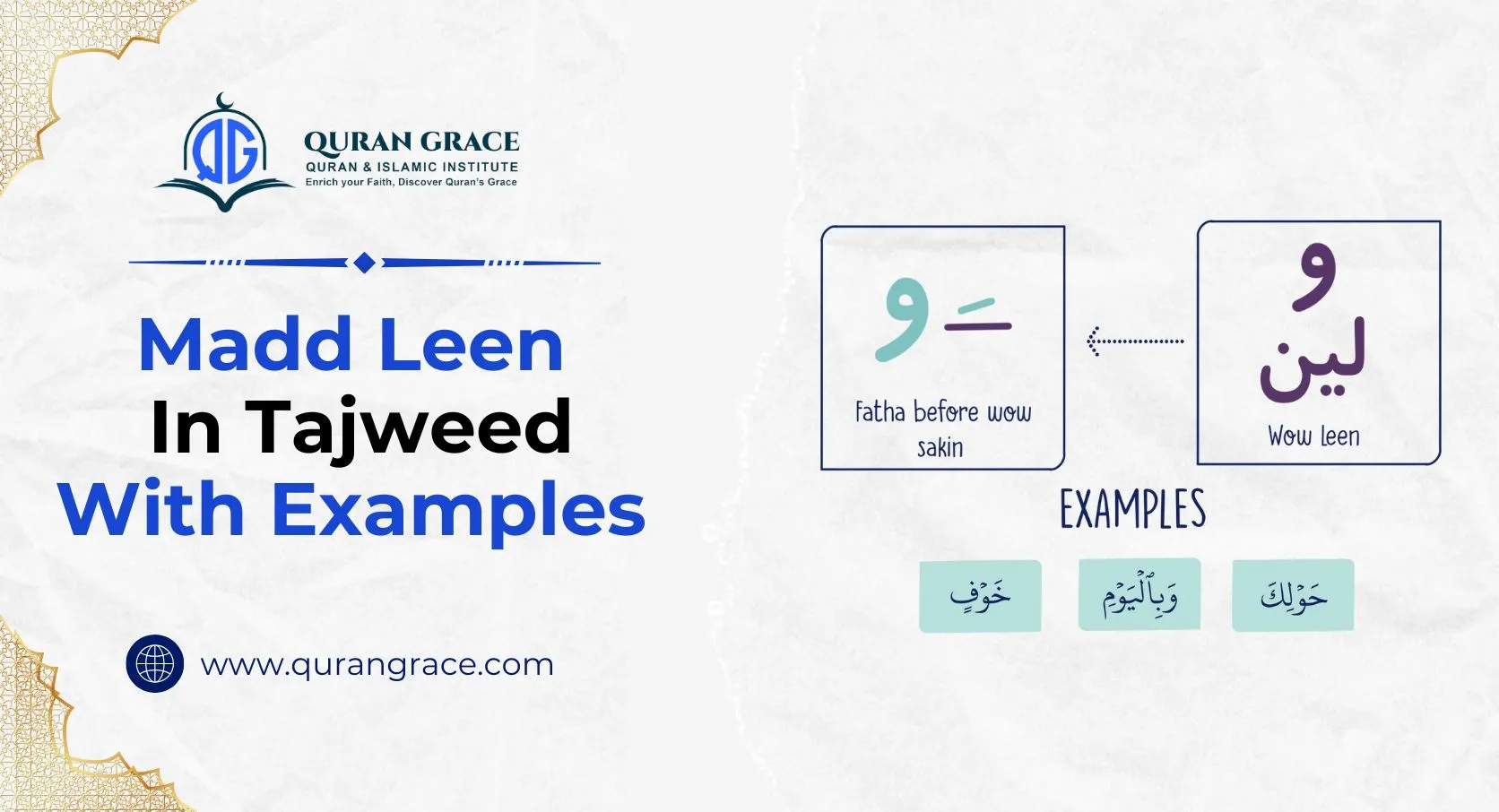
In Tajweed, the concept of Madd Leen pertains to the soft prolongation or extension of a sound that occurs when one encounters two specific letters. These letters are
- Waaw Saakinah (وْ): This is the Arabic letter “waw” marked with a sukoon, which indicates the absence of a vowel sound.
- Yaa Saakinah (يْ): This is the Arabic letter “yaa,” also marked with a sukoon.
For Madd Leen to be applicable, the letter preceding either the waaw saakinah or the yaa saakinah must have a Fatha ( َ ). A Fatha represents a short “a” sound in Arabic, similar to the “a” in the English word “cat.”
This elongation of Madd Leen only applies when you stop (waqf) on the word that contains the Madd Leen. If you continue reciting without pausing, Madd Leen does not apply. The letters simply maintain their normal, non-elongated sound.
Why “Leen”? (The Meaning of “Softness”)?
In Arabic, the word “Leen” (لين) itself means “softness” or “ease.” This sums up the pronunciation of these sounds perfectly. Without being harsh, they emerge from the mouth with ease and fluidity. This tenderness enhances the elegance and fluidity of Quranic recitation.
You can choose how long to prolong the sound when you come across Madd Leen and stop on the word. Scholars generally agree that you can extend it for:
- 2 counts (qasr): This is the shortest extension.
- 4 counts (tawassut): This is a medium extension.
- 6 counts (ishba’): This is the longest extension.
All three options for recitation are acceptable. The most important aspect is to maintain consistency throughout your practice. Suppose you decide to extend a Madd Leen for four counts during one instance. In that case, it is advisable to keep that same duration for all subsequent occurrences of Madd Leen in that particular recitation session. This approach ensures a harmonious and uniform delivery.
Examples of Madd Leen
Let’s look at some common examples from the Quran:
- خَوْفٍ (khawf): Here, you have a waaw saakinah (وْ) preceded by a letter with a Fatha (خَ). If you stop on this word, the “aw” sound will be prolonged.
- الْبَيْتِ (al-bayt): In this word, you have a yaa saakinah (يْ) preceded by a letter with a Fatha (بَ). If you stop on this word, the “ay” sound will be prolonged.
- الصَّيْفِ (as-sayf): Similar to “al-bayt,” the “ay” sound will be prolonged if you stop on it.
- قُرَيْشٍ (Quraish): Again, the “ai” sound will be elongated if you pause here.
Why is Madd Leen Important?
- Accurate Pronunciation: Mastering Tajweed ensures that you pronounce the words of the Quran precisely as intended in the divine revelation.
- Melody and Rhythm: It enriches the recitation with a delightful melodic quality and natural flow, making it more enjoyable to listen to and enabling proper pauses.
- Preventing Mistakes: Neglecting or misapplying Madd Leen can alter the meanings of words or interrupt the flow of the recitation.
- Deepening Connection: Reciting with accurate Tajweed, including Madd Leen, allows you to form a stronger bond with the words of Allah, enhancing your spiritual journey.
How to Learn Madd Leen
- Find a Qualified Tajweed Teacher: This is by far the most effective way. A good teacher can listen to your recitation, correct your mistakes, and guide you through the intricacies of Tajweed.
- **Listen Actively:** Pay attention to recitations by well-known Quranic reciters, focusing on how they implement Madd Leen and various quran tajweed rules.
- **Practice Regularly:** Consistent practice is essential for mastering any skill, and Tajweed is no exception. Begin with shorter verses and gradually work your way up to longer ones.
- **Utilize Resources:** Take advantage of the numerous online tools, books, and apps available for learning Tajweed. These resources can greatly enhance your understanding and practice.
Conclusion
Madd Leen is an important rule in Tajweed that enhances the softness and flow of your Quranic recitation. You can master this rule along with other essential Tajweed principles in our exclusive online Quran recitation classes. Quran Grace is offering a free evaluation and consultation for beginners worldwide. Join a free session today and enroll in the best online tajweed lessons for Tajweed rules.