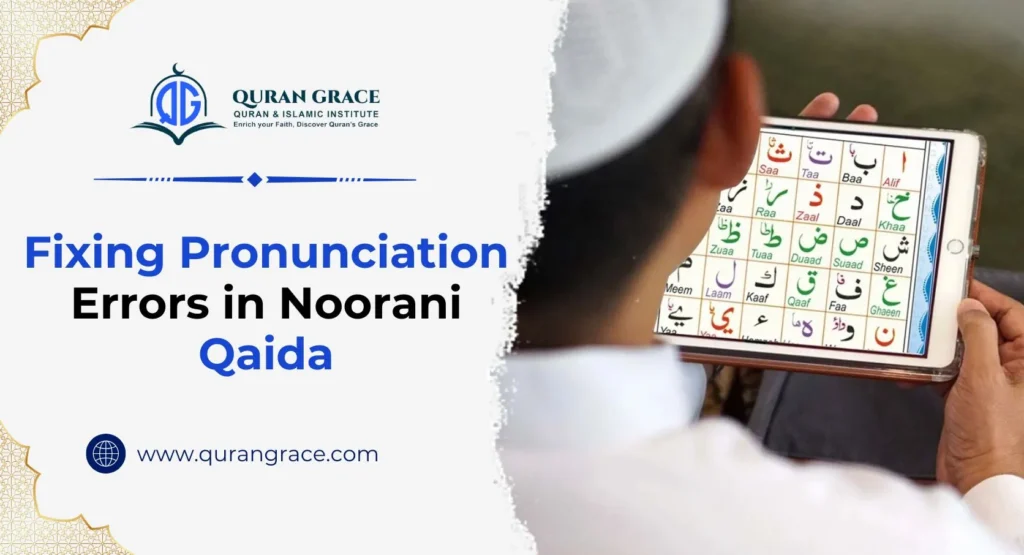

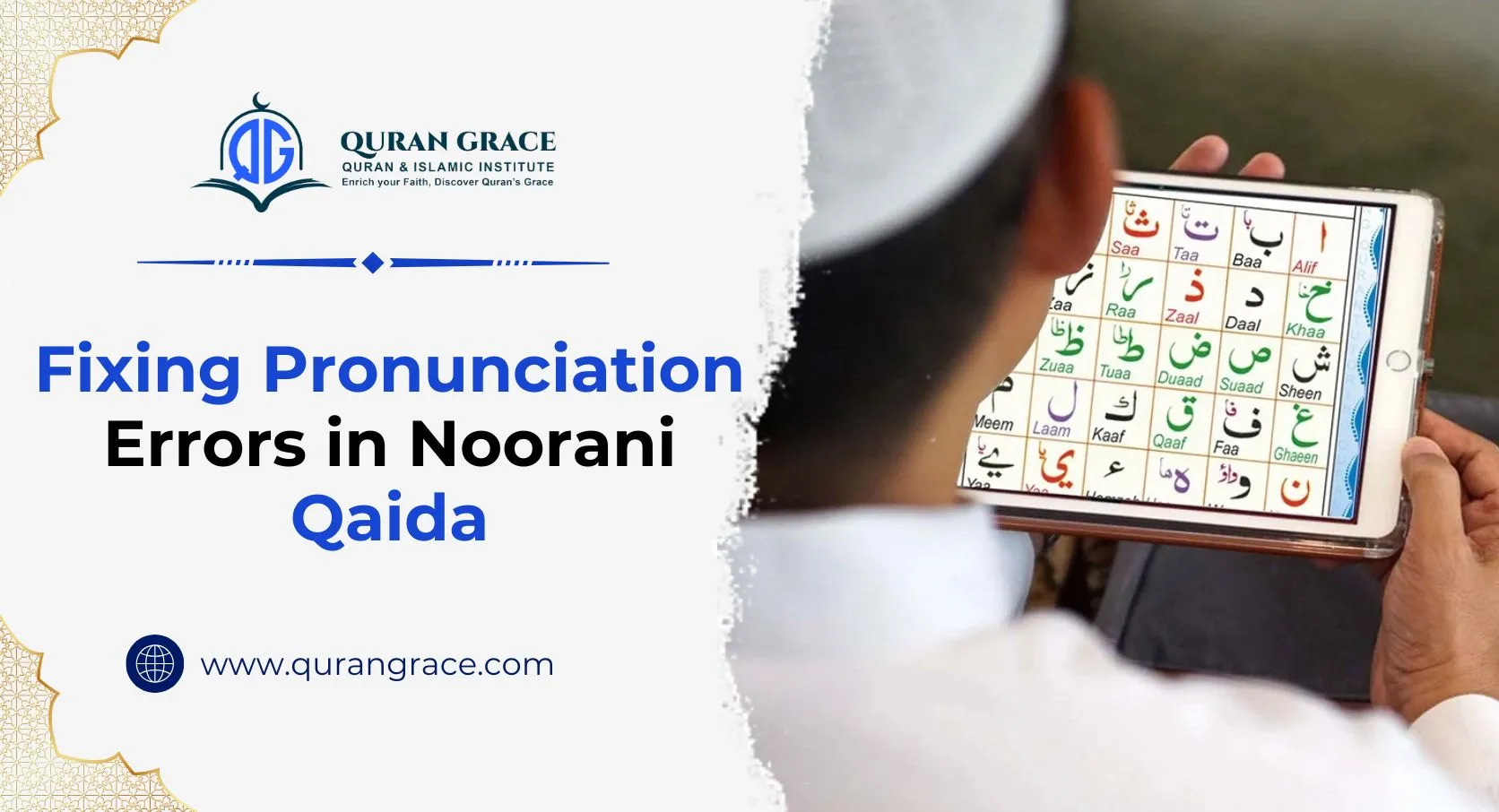
Starting your Quranic journey is an exciting milestone, and the Noorani Qaida is your very first map. It’s the foundation for everything. But many beginners (and even some adults) struggle with specific sounds that just don’t exist in English or Urdu.
If you feel like you’re “tripping” over your tongue or can’t tell the difference between two similar-sounding letters, don’t worry. You aren’t alone, and these are easy fixes once you know the “secret” spots in your throat and mouth.
Let’s look at the most common mistakes made by non-native students and how you can fix them.
Common Pronunciation Errors (And Their Simple Fixes)
The eminent teachers at Quran Grace have listed some common pronunciation errors in Noorani Qaida and given their simple fixes. Let’s explore them further.
1. Mixing Up “Heavy” and “Light” Letters
This is the most common hurdle. In Arabic, some letters are pronounced with a full, round mouth (Heavy), while others are thin and flat (Light).
- The Mistake: Pronouncing the heavy Qaaf (ق) just like the light Kaaf (ك).
- The Fix: For the Qaaf, imagine the sound coming from the very back of your tongue, hitting the soft palate. For Kaaf, move a little further forward. It’s the difference between a deep “Q” and a sharp “K.”
2. The “Ha” Confusion
There are two types of “H” sounds in the Quran, and mixing them up can actually change the meaning of Quranic words!
- The Mistake: Using the soft Ha (هـ) for the sharp Haa (ح).
- The Fix: Think of the sharp Haa (ح) as a “breathy” sound. Imagine you are trying to fog up a pair of glasses or your phone screen. That sharp, clean exhale from the middle of the throat is what you’re looking for.
3. Getting the “Z” Sounds Wrong
Arabic has several letters that sound like “Z” or “S” to the untrained ear (ز, ذ, ظ, ض).
- The Mistake: Using your teeth for everything.
- The Fix: * For Thaal (ذ), your tongue should gently touch the tips of your upper front teeth (like the word “The”).
- For Zaa (ز), keep your tongue behind your teeth so it whistles slightly (like a bee buzzing).
4. Rushing the Harakaat (Vowels)
- The Mistake: Stretching a short vowel (Fatha, Kasra, Dhamma) so long that it sounds like a long vowel (Mad).
- The Fix: Keep it snappy! A short vowel should only take one count. If you linger too long, you’re accidentally adding extra letters to the word.
Note: At Quran Grace, we specialize in helping students master these sounds through personalized feedback. Our Noorani Qaida Course is designed to take you from the very basics to confident recitation with ease.
5. Ignoring the “Throat” Letters (The Deep ‘Ain)
Many students treat the letter ‘Ain (ع) like a regular “A” or a glottal stop.
- The Mistake: Pronouncing ‘Ain as a flat “Ah” sound.
- The Fix: This letter comes from the middle of the throat. It requires a slight “squeeze.” Imagine the muscles in your throat tightening just a bit as you push the air out. It should sound distinct and “smooth,” not sharp like an Alif.
6. The “S” Sound Confusion (Seen vs. Saad)
Arabic has two very different versions of the “S” sound, and beginners often use the English “S” for both.
- The Mistake: Making the heavy Saad (ص) sound exactly like the light Seen (س).
- The Fix: To get the Saad (ص) right, don’t just use the tip of your tongue. Raise the back of your tongue toward the roof of your mouth. This creates a “hollow” or “whistling” echo in your mouth, making the sound thick and powerful rather than thin.
7. Misplacing the Tongue on ‘Daad.’
The letter Daad (ض) is famously known as the hardest letter in the Arabic language, so much so that Arabic is called “The Language of the Daad.”
- The Mistake: Pronouncing it like a simple English “D” or a “Z.”
- The Fix: A “D” sound uses the tip of the tongue against the back of the teeth. For Daad, you need to use the sides of your tongue against your upper molars. It’s a heavy, vibrating sound that fills the mouth.
8. Bouncing Letters That Shouldn’t Bounce (Qalqalah)
While some letters are meant to “echo” (the Qalqalah letters), students often accidentally bounce letters that should be stopped firmly.
- The Mistake: Adding a small “uh” sound at the end of a letter with a Sukoon (like saying ab-uh instead of ab).
- The Fix: Unless the letter is one of the five Qalqalah letters (ق, ط, ب, ج, د), your tongue should stay “glued” to the exit point of the sound until you are finished. Don’t let the air “pop” out!
Why Getting it Right Matters
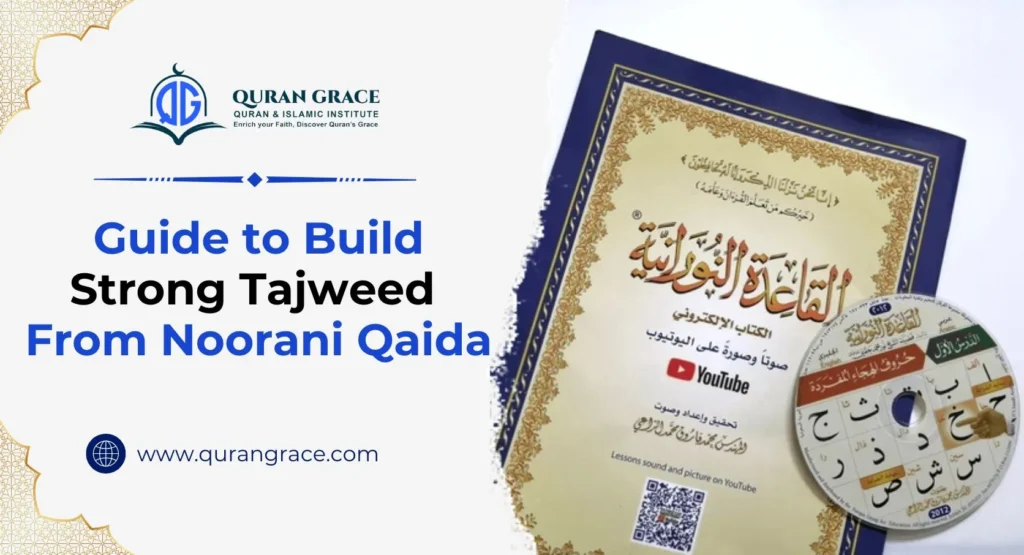
The Noorani Qaida book isn’t just a book of alphabets; it’s a manual for Tajweed. Learning the correct Makhraj (exit point of the sound) now means you won’t have to “unlearn” bad habits later when you start reciting the Holy Quran.
Pro Tip: Always listen to a teacher or a recording before you practice. Your ears need to learn the sound before your tongue can mimic it!
Conclusion
Perfecting your pronunciation takes patience, but it’s a journey that brings you closer to the beauty of the Quran. Every time you correct a letter, you are honoring the language of the Revelation. Take it one lesson at a time, be kind to yourself, and keep practicing!