
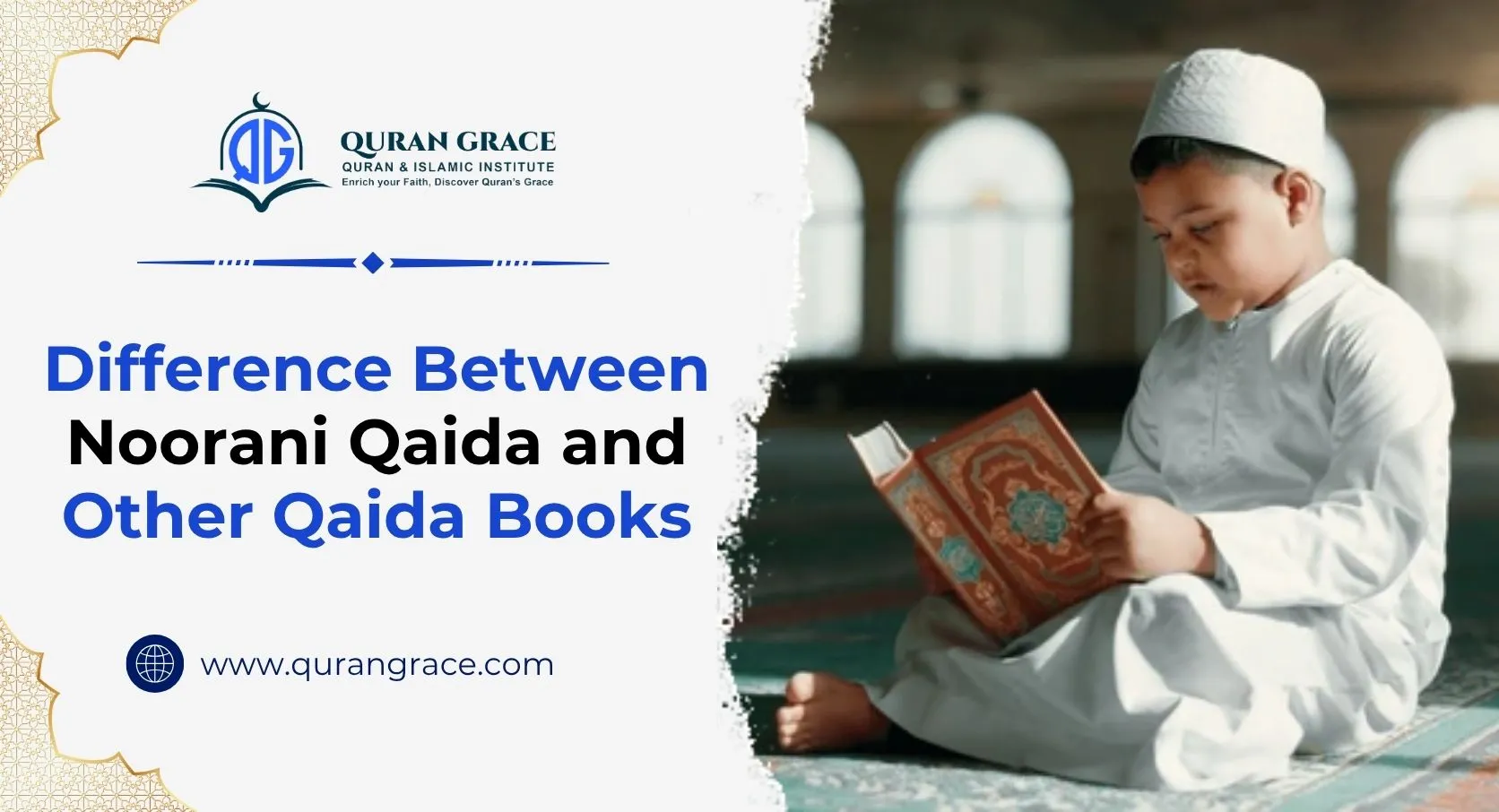
For generations, the foundational booklets have been the gateway for children and converts to master the Arabic alphabet and its phonetic accuracy. While many versions exist, the Noorani Qaida, compiled by Sheikh Noor Muhammad Haqqani, remains the most widely recognized curriculum globally. However, several other regional and modern variations, such as the Yassarnal Quran or the Madani Qaida course, offer alternative approaches.
Understanding the differences between these books can help tutors and parents choose the best tool for a student’s specific learning style. Here are the primary differences between the Noorani Qaida and other Qaida books listed by the tutors at Quran Grace Academy.
Table of Contents
ToggleKey Differences Between Noorani Qaida and other Qaida Books
1. Teaching Approach
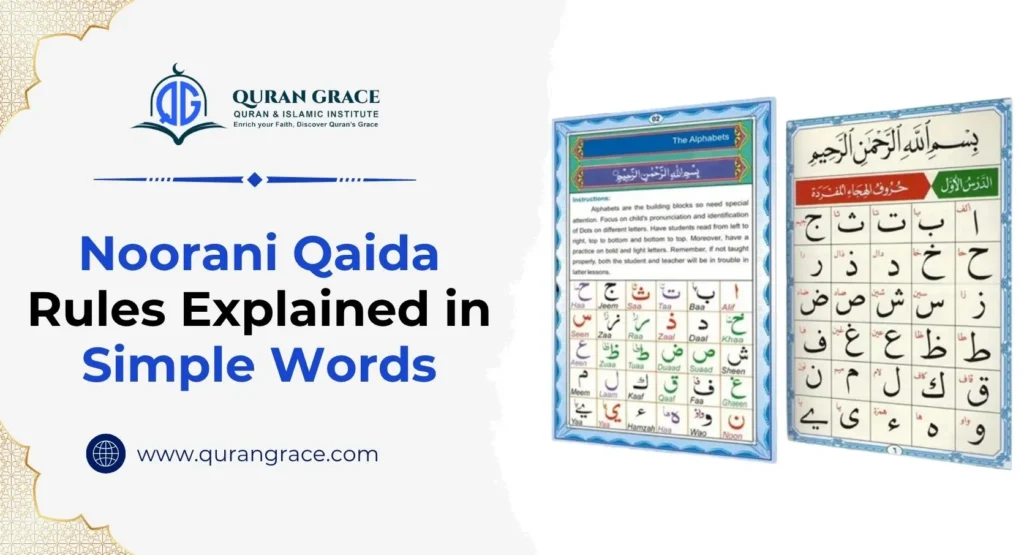
The Noorani Qaida is renowned for its structured and logical progression in teaching. It begins with the recognition of individual letters and gradually advances to compound letters (Murakkabat). Following this, it introduces vowels (Harakat) and culminates with more intricate rules such as Tanween and Jazm. In contrast, some other Qaida books may focus on “word recognition” from the outset. While this approach might seem quicker for some learners, it often overlooks the comprehensive phonetic foundation that the Noorani Qaida method offers.
2. Focus on Tajweed Rules
The Noorani Qaida course is specifically crafted as a Tajweed manual, with the primary objective of teaching Arabic reading. It emphasizes key concepts such as Makharij, or articulation points, through targeted exercises. In contrast, many regional Qaidas tend to focus more on basic literacy, aiding students in reading the Arabic script fluently. However, these often do not delve into the technical characteristics of each letter, known as Sifat.
3. Script and Calligraphy
The Noorani Qaida primarily utilizes the Indo-Pak (Persian) script, known for its bold and distinct characters along with specific vowel markings. In comparison, many contemporary Qaidas labeled as “Other” have embraced the Uthmani (Madinah) script, which is commonly found in the Mushaf used in Arab nations. This distinction in the representation of certain signs, such as the Sukun or Madd, can significantly influence a student’s ability to transition to reading the full Quran effectively.
4. Color-Coded Assistance
A key characteristic of contemporary Noorani Qaida editions is the use of color-coding. Different colors are designated to signify specific rules such as Ghunnah (nasalization), Ikhfa, or Qalqala. While many modern Madani or digital versions have incorporated this color-coding system, numerous traditional “Other” Qaidas continue to be printed in monochrome. This approach requires students to learn the rules through memorization and logical reasoning, rather than relying on visual cues.
5. Vocabulary Selection
The Noorani Qaida is designed to be “Quran-centric,” emphasizing a direct connection to the Quran. Most exercises and vocabulary presented in the book are derived directly from the Quranic text. In contrast, other Qaida books may include common Arabic words not found in the Holy Book, aiming to expand vocabulary or simplify the learning process for younger learners.
6. Complexity of Exercises
The Noorani Qaida is recognized for its structured drills that enhance students’ reading skills. It frequently presents extended sequences of compound letters that test both the learner’s breath control and letter recognition abilities. In contrast, other resources like the Yassarnal Quran are often viewed as more accommodating for beginners. They typically feature shorter exercises and increased white space on the page, helping to create a less intimidating environment for young learners.
7. Regional Popularity and Teacher Availability
The Noorani Qaida has served as a standard teaching tool for over a century, resulting in a worldwide network of educators skilled in its instruction. This consistency allows students to seamlessly continue their Quranic studies when relocating to a different city, as they can readily find teachers familiar with the same curriculum. In contrast, other al-Qaeda books tend to be more region-specific. For example, a student who has learned using a particular Malaysian or Turkish Qaida may encounter challenges in finding a tutor who employs that same teaching methodology in another country.
Conclusion
Choosing between the Noorani Qaida and other variants is not a matter of “better or worse,” but rather a matter of alignment with goals. The Noorani Qaida is the “gold standard” for those seeking a rigorous, Tajweed-heavy foundation that prepares the tongue for the precise articulation required by the Quran. Other Qaida books offer valuable alternatives for those who prefer different scripts or a slightly more accelerated path to basic fluency. Regardless of the choice, the goal remains the same, and you can enroll in the Noorani Qaida online course at Quran Grace to learn it systematically and in a structured way