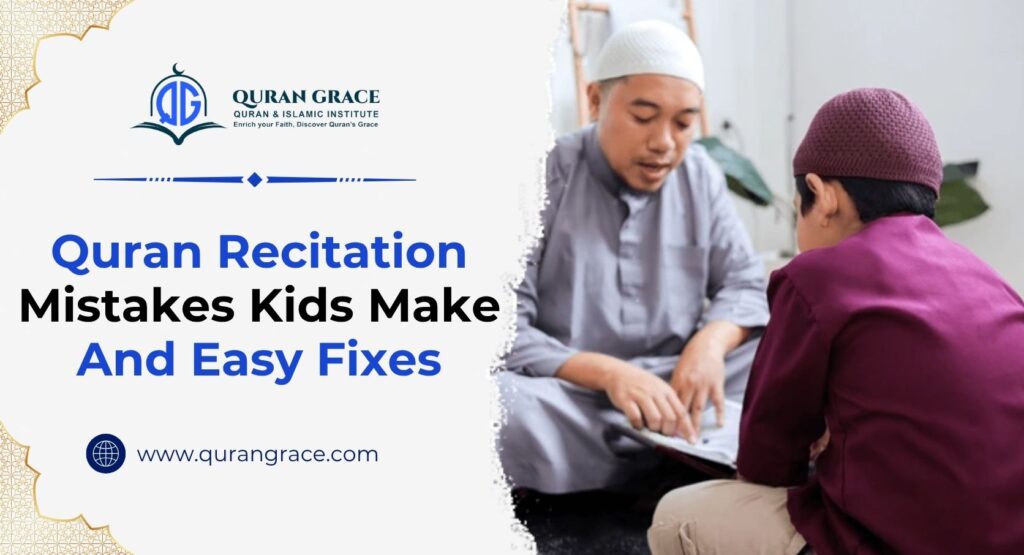

Making mistakes while reciting the Quran is a common aspect of the learning process for children. In Tajweed, these errors are categorized as Lahn, which can vary in severity. Minor mistakes might include slightly short vowels, while major mistakes can alter the meaning of a word entirely.
At Quran Grace, we are committed to nurturing the potential within every child, believing that there is a “Qari” in each of them that simply needs refinement. Below are some of the most frequent mistakes children encounter, along with effective strategies used by online egyptian quran teachers to address and correct these issues.
Table of Contents
ToggleCommon Recitation Mistakes Kids Make & How Online Teachers Fix Them
1. Makharij Errors in Arabic Pronunciation
In the Arabic language, certain letters can be quite similar in sound, which can lead to confusion, especially for beginners. Commonly, children may inadvertently substitute the sharp “Saad” (ص) for the softer “Seen” (س) or mix up the deep “Qaaf” (ق) with the lighter “Kaaf” (ك). For example, mispronouncing “Qalbin” (heart) as “Kalbin” (dog) can alter the meaning of a verse significantly.
To address these pronunciation challenges, online educators at Quran Grace implement visual articulation drills. By utilizing webcam technology, teachers can demonstrate the precise tongue placement needed for each letter. Additionally, they incorporate enjoyable analogies—such as likening the sound of throat letters to that of a “frog”—to help students perceive the necessary vibrations and effectively master the Makharij, or articulation points of Arabic letters.
2. The Fast Recitation
Many children misunderstand Tajweed, often perceiving it as a race to complete verses quickly. This leads to rushing through recitations, where they may skip over the Harakat (vowel markings) and overlook important pauses. Such rushing can result in slurred pronunciation, which diminishes both the rhythm and the spiritual essence of the Quran.
To address this, online tutors implement the “Traffic Light” method. This technique encourages children to identify stop signs (Waqf) in the Quran as they would a red light, prompting them to pause. Additionally, tutors utilize digital color-coded Mushafs to clearly indicate where students should slow their pace and take breaths, transforming the hurried recitation into a melodious experience.
3. Problem with the Madd application
One common error students make is mismanaging the length of vowel sounds in their reading. Often, they stretch a letter for either too long or too short a duration, disrupting the natural flow of the verse. This issue is particularly prevalent among younger learners, who may default to treating every vowel as a short sound, resulting in a choppy, uneven rhythm that lacks the smoothness essential for engaging poetry or musicality in language.
To address this issue, rhythmic counting becomes a valuable tool in helping students master the appropriate length for their vowel sounds. Teachers can incorporate a variety of methods, such as using hand gestures to indicate the timing or utilizing digital tools that produce beats or rhythms. By tapping into the concept of musical counting, educators can teach students how many counts or beats each letter should have, transforming this practice into a dynamic and enjoyable lesson. Once a child begins to feel the rhythm and tempo, their ability to stretch the letters correctly improves remarkably, allowing their Madd to shine with precision and fluidity.
Note: This approach not only enhances their recitation skills but also builds a stronger connection between Arabic and its meanings.
4. The missing Qalqalah
A frequently overlooked element is the “Missing Echo” (Qalqalah). Many children fail to produce the bouncing sound associated with letters like Baa (ب) or Dal (د), resulting in a flat pronunciation when these letters have a Sukun.
To enhance their learning, tutors employ interactive audio mimicry in online Tajweed classes, allowing for clear audio exchange. The teacher demonstrates the “bounce,” and the child replicates it, akin to an echo game. This method adds an element of fun, creating a “ping-pong” effect that enhances their Quran recitation skills.
Why Online Learning is the Game Changer
Correcting a child’s recitation requires patience and, most importantly, undivided attention. In a crowded local classroom, a teacher might miss a small slip-up.
In a one-on-one setting, every single breath is heard. Our tutors don’t just “correct”—they build confidence. They use digital rewards, storytelling, and progress trackers to keep the “oops” moments from becoming “I give up” moments.
Ready to help your child recite with grace? Check out our Online Classes for Kids and watch them transform from a hesitant beginner to a confident reciter!
Conclusion
Correcting mistakes early is the best gift you can give your child’s spiritual future. By catching these common errors now, we ensure they don’t become permanent habits. Remember, every mistake corrected is a step closer to the “perfect” recitation that pleases Allah (SWT).
At Quran Grace, we are committed to guiding students with expert teachers, structured lessons, and personalized attention to ensure lasting improvement. If you’re looking for the right support, our online Quran recitation course is designed to help your child learn correctly, grow consistently, and develop a deep connection with the Quran.