
Learning the Quran is a journey of profound spiritual growth, but to truly unlock its blessings and understand its message, one must recite it correctly. This isn’t just about reading the Arabic script; it’s about giving every single letter its due right. At the heart of this precise recitation lies the science of Tajweed, and its foundational cornerstone is Makhaarij Al-Huroof, the correct articulation points of the Arabic letters. This is why a structured tajweed course is essential—without mastering the makharij al-huroof, no one can truly perfect the rules of Tajweed or achieve accurate Quranic recitation.
What is Makharij Al-Huroof?
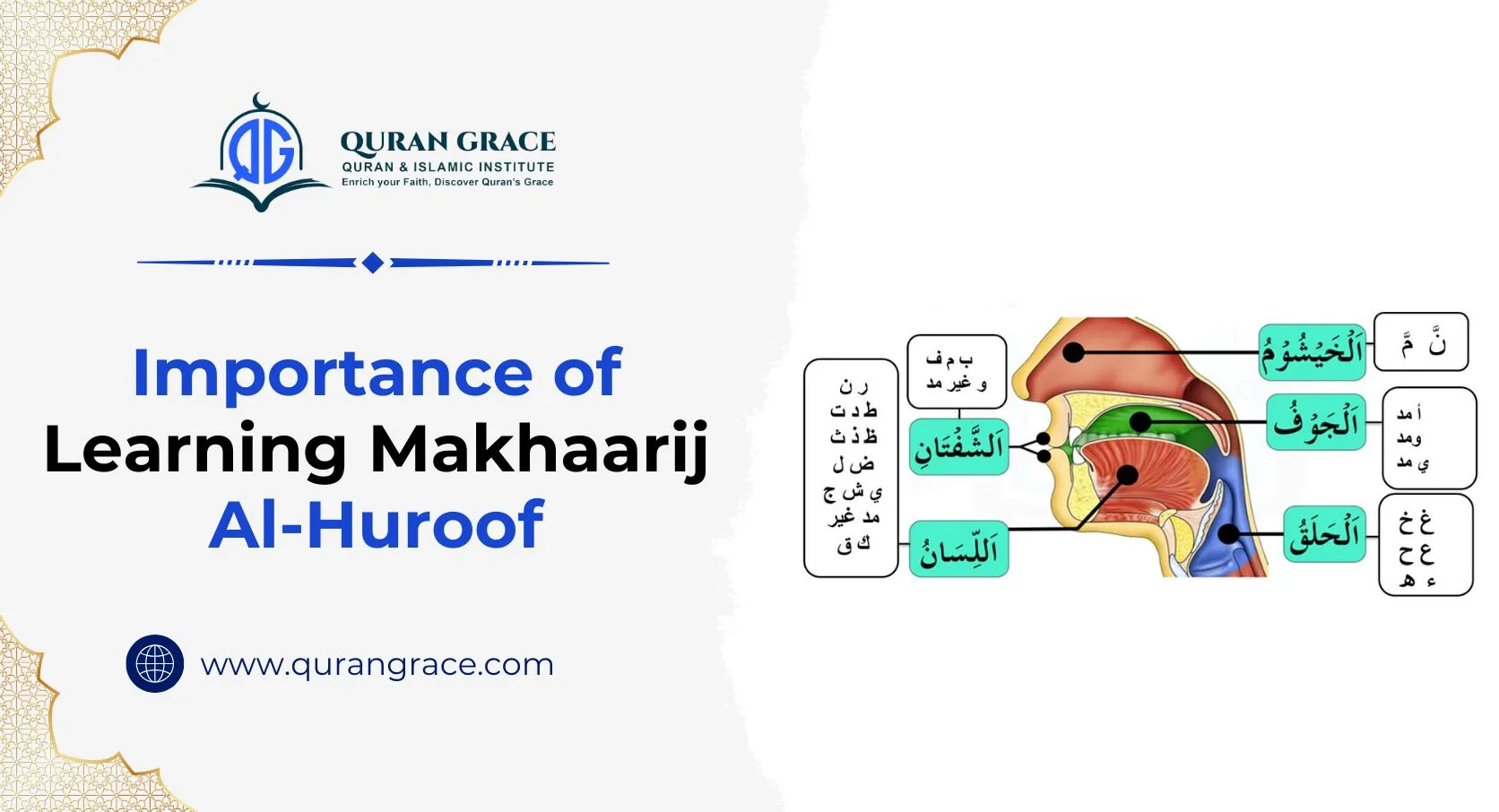
In the context of Tajweed, Makharij Al-Huroof refers to the exact location in the mouth, throat, or nasal cavity from which a specific Arabic letter is produced. There are generally 5 primary articulation areas in total, each containing 17 specific Makhaarij for the 29 letters of the Arabic alphabet.
These five primary areas are:
- Al-Jawf (The Empty Space): The general space running through the mouth and throat. This is the origin of the three prolongation/vowel letters (Alif, Waw, Yaa) when they are silent and preceded by their corresponding short vowel.
- Al-Halq (The Throat): Divided into three specific points (lowest, middle, and highest) where six letters originate: ε˙, Z˙, ع, ح, أ, ه.
- Al-Lisaan (The Tongue): This is the most complex area, containing ten specific points for 18 letters, ranging from the root of the tongue to its tip.
- Ash-Shafataan (The Two Lips): The origin of four letters: ف, ب, م, و (non-vowel).
- Al-Khayshoom (The Nasal Cavity): The articulation point for the sound of Ghunnah (nasalisation), which is a characteristic of the letters ن and م.
Importance of Learning Makharij Al-Huroof
The emphasis on Makhaarij is not an act of unnecessary complication; it is a fundamental pillar of preserving the Quranic text and achieving a sound and meaningful relationship with the Divine Word.
1. Preserving the Meaning (Hifz Al-Ma’na)
This is the single most critical reason. In Arabic, changing the articulation of a single letter can drastically alter or completely invert the meaning of a word, sometimes changing a phrase of praise into one of blasphemy.
- Example 1: The Letter س vs. ص
- The word قسطاس (Qistās) means ‘balance’ or ‘justice’.
- If the س (articulated from the tip of the tongue with the incisors) is replaced by ص (a heavier, emphatic letter from the same area), the meaning is lost or corrupted.
- Example 2: The Letter ع vs. أ
- The word نعْمَة (Ni’mah) means ‘blessing’.
- If the ع (from the middle of the throat) is pronounced as an أ (from the bottom of the throat), the word becomes نأْمَة (Na’mah), which means ‘moaning’, a completely unacceptable change when referring to God’s blessings.
When a reader makes an error that changes the meaning (Lahn Jali – Obvious Mistake), they are considered to have erred gravely, potentially invalidating the recitation and even a prayer based on that recitation.
2. Fulfilling the Rights of the Letters (Haqaaiq Al-Huroof)
Every Arabic letter has a specific Makhraj (its place of exit) and Sifaat (its characteristics, such as heaviness, lightness, whistling, etc.). Learning the Makhaarij is the primary step in giving the letter its right to be produced correctly.
By correctly locating the articulation point, the reciter ensures that the letter maintains its unique identity. Without proper Makhaarij, letters become indistinct (e.g., ت sounding like ط, or ذ sounding like ز), which undermines the precision and eloquence of the Quranic text.
3. Following the Sunnah and Preserving the Revelation
The Prophet Muhammad (peace be upon him) recited the Quran according to the precise rules of Tajweed, which were revealed to him by the Angel Jibreel (peace be upon him). The transmission of the Quran (Talaqqi) has been an unbroken chain for over 14 centuries, with teachers correcting students’ pronunciation letter by letter.
Learning Makhaarij is an act of Ittibā’ (following) the Sunnah (Prophetic tradition) and an essential means of safeguarding the Quran from linguistic corruption, ensuring it is read today exactly as it was revealed.
4. Enhancing Spiritual Connection and Reward
Reciting the Quran correctly is an act of worship that earns immense reward. The Prophet Muhammad (peace be upon him) said: “The one who is proficient in the recitation of the Qur’an will be with the noble and obedient scribes (angels), and the one who recites the Qur’an and finds it difficult to recite, doing his best to recite it in the best way possible, will have two rewards.” (Sahih Muslim)
The “proficient one” is often interpreted as the one who masters the rules of Tajweed, including Makhaarij and Sifaat. The effort required to perfect one’s articulation is itself a rewarded act of devotion, leading to a deeper sense of Khushu’ (humble submission) during recitation and prayer.
5. Get perfection through practice
Mastering the articulation points requires a methodical and consistent approach. One must first learn the theoretical framework: the names of the five primary areas, the 17 specific Makhaarij, and which letters belong to each point. This provides the mental map necessary for practice.
Theory alone is insufficient. The most effective way to master Makhaarij is through Mashaafahah (face-to-face learning) with a qualified teacher. The teacher listens, identifies the errors in articulation, and guides the student by demonstrating the correct placement of the tongue, lips, and flow of air. The key technique often used is pronouncing the letter with a Sukun (vowelless) preceded by a Hamzah (A-b, I-j, U-t) to clearly locate the point of exit.
The different letters that share similar Makhaarij—known as “Huroof Mutajānisah” (homogenous letters), such as ت and ط, or ذ and ظ—require diligent practice to distinguish them clearly. Consistent daily recitation, focusing on applying the learned rules, is crucial for turning conscious effort into an unconscious, habitual part of recitation.
Conclusion
It is the necessary prerequisite for reading the Quran accurately to understand and practice Tajweed. It transforms recitation from a mere reading exercise into a divine conversation, ensuring that the words spoken are the same as those that were heard and preserved over a millennium ago.
Every Muslim who seeks to draw closer to the Creator must therefore prioritize this fundamental knowledge, making the effort to perfect their articulation as a sign of reverence and love for the Holy Quran. At Quran Grace, this commitment is nurtured through structured learning and personalized guidance, helping students refine their recitation through a carefully designed advanced tajweed course that preserves the beauty, accuracy, and sanctity of Allah’s words.