
The Prophet Muhammad SAWW said:
“Keep on reciting the Qur’an, for, by Him in Whose Hand my life is, the Qur’an runs away (is forgotten) faster than camels that are released from their tying ropes.”
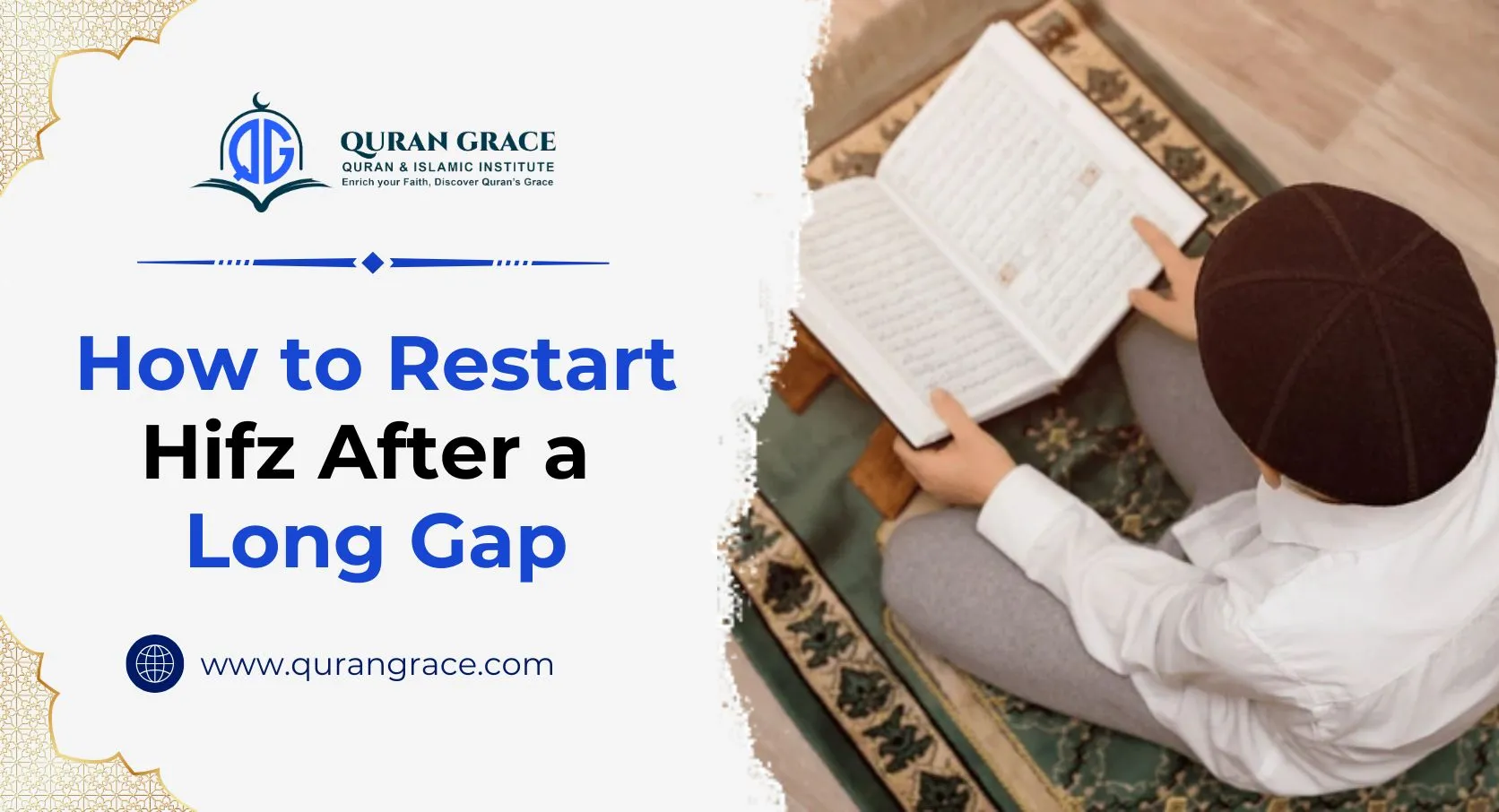
Forgetfulness is a natural, human phenomenon. Your return is a sign of immense love and sincerity. Not only do you require dedication, but you also need to revise the forgotten portion with perfection. This guide will provide a structured, compassionate, and effective plan to help you not just restart, but to build a stronger, more lasting connection with your Hifdh course.
8 Tips to Restart Hifz After a Long Gap
Let’s delve deep into the tips and explore easy ways to restart hifdh.
1. Renew Your Intention (Niyyah)
Before you open the Mushaf (the physical copy of the Qur’an), you must first prepare your heart and mind. This is the foundation of your comeback. Your Niyyah is the fuel of your journey. Take a few moments of sincere reflection.
The fact that you are trying to restart is an accepted repentance and a fresh start. Make dua and ask for ease, consistency, and retention.
2. Make an Honest Self-Assessment
You need a clear picture of your current state—not to feel discouraged, but to create a precise map for recovery. Recite what you remember best from memory, without looking. Identify three categories:
- Portions you can recite fluently with minimal mistakes.
- Portions you can recall with prompting or moderate mistakes.
- Portions that have completely faded and feel like new memorisation.
Use the same copy of the Qur’an (with the same script and page layout) that you used before. Visual consistency is a powerful tool for memory recall.
3. Focus on Revision First
The key to a successful comeback is starting small and being consistent. You are not starting from scratch; you are rebuilding on a foundation that needs reinforcement.
- Do not jump into new memorisation immediately. Your priority is to strengthen what you already have. Begin by simply reciting a set amount of the Qur’an by looking at the Mushaf every day.
- Start with 1-2 pages daily, perhaps after Fajr or Maghrib prayer. The goal is fluency in reading the Arabic text again. After a few weeks of consistent reading, slowly increase your Wird to half a Juz (10 pages), and then one full Juz (20 pages) a day. The aim should be to complete a full reading of the Qur’an every 30 days. This simple, consistent exposure is the most potent weapon against forgetfulness.
- Start your Hifz review with the sections you marked as strong. Recite these from memory, making them a 9/10 or 10/10 in fluency. This builds confidence and creates an early “win.”
4. Implement the Three-Tiered Revision System
This system is universally effective for long-term Hifz retention and is perfect for overcoming a break.
| Tier | Focus | Frequency | Daily/Weekly Commitment |
| Daily | Your weakest portions | Every day | 1-3 pages maximum |
| Weekly | The last few Juz (sections) | Once a week | 1-5 Juz (depending on your total Hifz amount) |
| Monthly | Your entire Hifz portion) | Once a month | 1 Juz per day |
Example of Daily Implementation:
- 20 minutes after Fajr: Re-memorize 1 page from your forgotten portion (Tier 1).
- 10 minutes before Dhuhr: Review 5 pages from your Needs Review portion (Tier 2/Daily Wird).
- During Salah (Prayer): Recite a portion of your Hifdh (Tier 3/Monthly) in your voluntary prayers.
5. Introducing New Memorisation
Only begin a new lesson after you have established a consistent daily review routine for at least 4-6 weeks and feel confident in your Tier 1 portions.
- A few lines or 3-5 Ayat (verses) is a perfect, realistic starting point.
- This scientifically proven technique is essential for long-term memory.
- Day 1: Memorize the new Ayat.
- Day 2: Review the new Ayat.
- Day 4: Review again.
- Day 7: Review again.
- Day 14: Review again, and so on.
6. Find a Teacher or Buddy (Accountability)
This is the most crucial step. Technology is helpful, but the accountability of a real person is transformative.
- Get a teacher or a reliable friend to listen to your daily portion. This forces accuracy and prevents mistakes from becoming cemented in your memory.
- Even a virtual Hifz circle provides a sense of community, shared struggle, and motivation.
Note: Quran Grace offers amazing one-on-one and group classes for hifdh where students revise their old portions and perfect them together.
7. Apply Multi-Sensory Techniques
Engage more than just your eyes to deepen memory encoding.
- The Audible Advantage: Recite aloud every single time you review or memorize. Hearing your own voice strengthens the memory pathway. Listen to a skilled Qari (reciter) before you start.
- Visual-Kinesthetic Link: Trace the verses with your finger while you read from the Mushaf. This connects the visual script to a physical action.
- Write It Down: If you struggle with a specific Ayah or passage, write it out by hand multiple times. This forces deep, active recall.
8. Integrate Hifdh into Your Daily Routine
Hifz should not be a task you fit in, but a habit you build upon.
| Strategy | Time Frame |
| Habit Stacking | Recite after every Fard prayer. |
| Morning Barakah | Dedicate 15-30 minutes after Fajr to your most challenging memorisation. |
| The Power of Micro-Sessions | Two 20-minute sessions are often more effective than one 40-minute session. |
Conclusion
Restarting your hifz is not just about bringing verses back to your memory; it is about reviving a relationship with the Quran. At Quran Grace, we understand that there will be days of frustration, but with consistent effort, you can achieve your goals. Whether you are looking for a hifz course for kids, an adults hifz course, or specialized ladies hifz classes, Quran Grace can help devise a personalized plan and guide you in revising your forgotten hifz effectively.