

Reciting the Quran with proper pronunciation is an important act of worship for Muslims worldwide. For many individuals, particularly non-native Arabic speakers, mastering this pronunciation can be perceived as a significant challenge. The intricacies of the Arabic letters, the established rules of Tajweed, and the distinct flow of the Quranic text all play a vital role in both the beauty and complexity of correct recitation.
Enrolling in tajweed lessons for beginners can provide a structured way to overcome these challenges, ensuring learners understand each rule step by step. This blog post serves as a comprehensive guide, helping individuals improve their Quranic pronunciation and transforming what may seem like a daunting task into a fulfilling and spiritually enriching journey.
Table of Contents
ToggleUnderstanding the Arabic Alphabet and Makharij
To effectively engage in Quranic recitation, establishing a strong foundation is essential. This foundational aspect encompasses a comprehensive understanding of the Arabic alphabet and the specific articulatory points known as Makhraj.
-
The Arabic Alphabet
The Arabic language consists of 29 letters. Unlike the English alphabet, each Arabic letter corresponds to a distinct sound that is produced from specific locations within the mouth or throat.
-
Makharij (Points of Articulation)
Mastering Makhraj is critical for accurate recitation. It refers to the precise origin of each letter’s sound. For instance, some letters are articulated from the front of the mouth, while others arise from the back of the throat or various positions of the tongue or lips. Even slight mispronunciations can alter the meaning of words, making correct pronunciation essential.
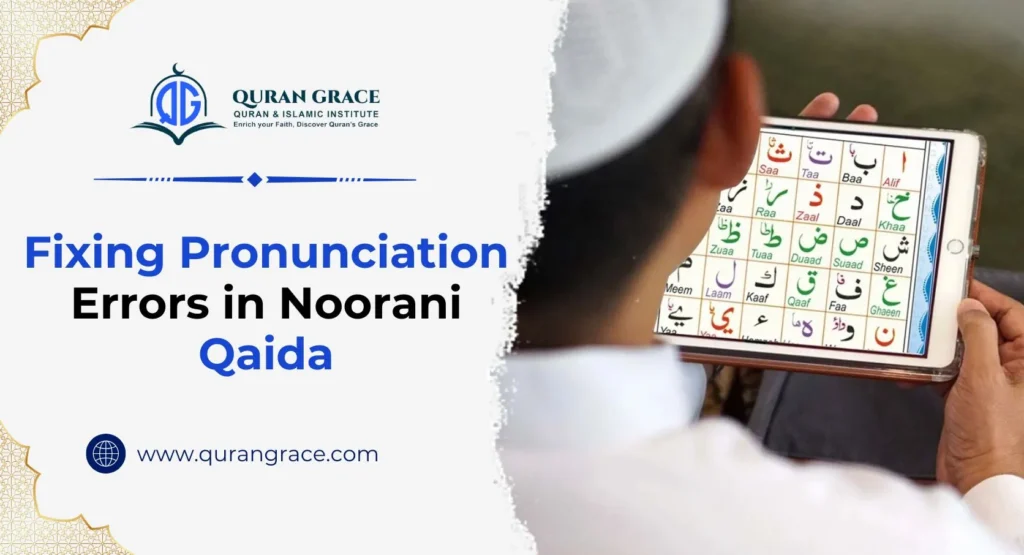
To aid in learning, it is beneficial to consult a trustworthy Tajweed chart, either online or in print, that illustrates the Makhraj for each Arabic letter. Practice the sound of each letter individually, paying careful attention to the positioning of your tongue, lips, and throat to ensure accurate pronunciation.
Understanding the Rules of Tajweed
Tajweed refers to the art of improving and beautifying the recitation of the Quran. It encompasses the rules of correct pronunciation, intonation, and rhythm, emphasizing not only the accurate articulation of letters but also assigning each letter its appropriate significance while minimizing errors.
While Tajweed includes various detailed rules, here are some essential concepts to get started:
-
Noon Sakinah and Tanween
These rules address the pronunciation of the silent letter “N” (Noon Sakinah) and the double vowel sounds represented by Tanween. They cover methods such as Idgham (merging), Ikhfa (hiding), and Izhar (clear pronunciation) depending on the letters that follow.
-
Qalqalah
This principle applies to five specific letters: Qaf, Ta, Ba, Jeem, and Dal. When these letters appear with a Sukun (a silent marker), they are pronounced with a distinctive echoing or bouncing sound.
-
Madd (Elongation)
This rule describes how to properly stretch vowel sounds. There are several types of Madd, each requiring a specific duration of elongation, commonly measured in counts, such as 2, 4, or 6 counts.
-
Ghunnah (Nasalization)
Ghunnah is the nasal sound that comes from the nose and is an essential part of the pronunciation of the letters $\meem$ and $\noon$. It is a constant feature of these two letters, but its length is extended in certain situations, such as when they have a shaddah (doubling sign) or when the rules of Ikhfa or Idgham apply.
-
Waqf and Ibtida (Pausing and Starting)
This set of rules guides the reciter on where to pause and where to begin recitation to maintain the correct meaning of the Quranic verses. The Quran has specific symbols to indicate mandatory stops, permissible stops, and places where a stop is not allowed.
One of the most effective ways to master these Tajweed rules is through repetition. By reciting verses and applying the specific rules being learned, and then repeating them numerous times, one can reinforce correct pronunciation and technique into muscle memory.
Practical Steps to Master Pronunciation
Mastering Quranic pronunciation is a journey that unfolds over time rather than a final destination. Here are some practical steps to help you make steady progress along the way:
1. Find a Qualified Teacher
This is perhaps the most effective step you can take. A skilled quran teacher can listen to your recitation, pinpoint your mistakes, and offer real-time corrections. They can also clarify complex quran Tajweed rules in a way that makes them easier to grasp. Consider looking for a local Madrasah or an online Tajweed tutor to guide you.
2. Listen and Imitate
Tune into recordings of renowned and respected reciters (Qaris) such as Sheikh Abdul Basit, Sheikh Mishary Alafasy, or Sheikh Saud Al-Shuraim. Pay close attention to how they articulate each letter, where they take pauses, and how they apply the rules of Tajweed. Afterward, try your best to imitate their recitation.
3. Record Yourself
Take the time to record your recitation and listen to it afterward. This can be a humbling experience, but it’s a great way to catch mistakes you might miss while reciting. Comparing your recording to that of a professional reciter can also pinpoint areas for improvement.
4. Use Tajweed Apps and Resources
There are many fantastic mobile apps and websites available to assist you in learning Tajweed. These platforms often offer interactive lessons, quizzes, and even features that highlight Tajweed rules within the text of the Quran.
5. Recite Regularly, Even in Small Portions
Consistency is key to progress. Make it a routine to recite a few verses daily, focusing on accurate pronunciation rather than speed. Even just ten minutes of focused, deliberate practice can be more beneficial than an hour of hurried recitation.
Conclusion
Mastering Quranic pronunciation is more than just a linguistic exercise; it’s a spiritual journey. By taking the time to learn and apply the rules of Tajweed, you are welcome to join Quran Grace online tajweed classes, as we offer free evaluation and consultation for beginners. Join us today to perfect your Quran recitation!