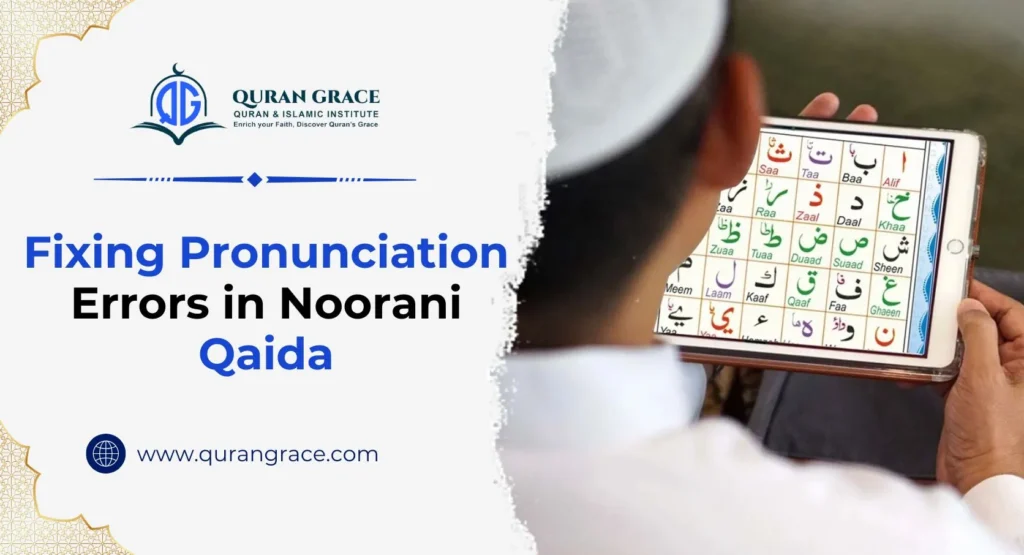


For many students, the journey to master the Tajweed rules can seem daunting, especially when learning online, and the tutors have to put in a lot of hard work into it. The first and most crucial step for any Tajweed teacher is active listening. Before offering corrections, our egyptian quran teachers carefully listen to a student’s recitation, often several times.
This initial assessment allows them to identify recurring errors, pinpoint specific letters or rules that are consistently misapplied, and understand the student’s current level of proficiency. This diagnostic phase is vital for tailoring the learning approach to each individual.
Table of Contents
ToggleHow Tutors Correct Tajweed Errors
The tutors at Quran Grace have spent time chalkboarding the tips to correct Tajweed errors. Here are some ways teachers use to correct Tajweed mistakes.
1. Focused Repetition and Articulation Points (Makharij)
One of the most common challenges in Tajweed is mastering the correct articulation points of Arabic letters. Many letters, especially those unique to Arabic, require precise positioning of the tongue, lips, and throat. Our teachers address this by:
- Clearly demonstrating the correct sound and mouth position, often using visual aids or encouraging students to mimic their movements.
- Having students repeat specific words, phrases, or even individual letters multiple times until the correct Makhraj is consistently achieved.
- Providing clear, concise instructions on where to place the tongue, how much air to release, or how to shape the lips for each letter. For example, distinguishing between the “Ha” from the chest and the “Ha” from the throat.
2. Emphasising Qualities of Letters (Sifat)
Beyond the articulation point, each Arabic letter possesses unique qualities (Sifat) that affect its sound. These include characteristics like boldness (Tafkheem) or lightness (Tarqeeq), whistling (Safeer), or elongation (Qalqalah). Teachers focus on these by:
- Clearly explaining the Sifat associated with a letter and the impact it has on pronunciation.
- Providing examples that highlight the difference between a letter recited with its correct Sifat versus an incorrect one.
- Sometimes, teachers encourage students to exaggerate a Sifat initially to help them feel and produce the correct sound, gradually refining it to a natural flow.
3. Mastering the Rules of Noon Sakinah and Tanween
The rules concerning Noon Sakinah and Tanween are fundamental to proper Tajweed and often present difficulties for learners. These rules include Izhar, Idgham, Ikhfa, and Iqalb. Our teachers utilize:
- Providing specific exercises designed to practice each rule in isolation and then in combination within verses.
- Helping students hear the subtle differences in sounds between Izhar and Idgham, for instance, through careful listening and immediate correction.
- Guiding students to apply these rules naturally within the context of actual Quranic verses, moving beyond rote memorization of the rules to practical application.
4. Correcting Elongations (Mudood) and Pauses (Waqf)
The correct application of elongations (Mudood) and understanding where to pause (Waqf) and resume (Ibtida) in recitation are crucial for maintaining the meaning and beauty of the Quran.
- Teachers guide students on the correct duration of each type of Madd (e.g., two counts, four counts, six counts), often using finger counting or rhythmic cues.
- Explaining the different types of Waqf and their implications for meaning, helping students choose appropriate stopping points.
- Offering advice on breath control to ensure students can sustain the correct Mudood and complete phrases gracefully without gasping for air.
5. Overcoming Common Regional Accents
Many students come from diverse linguistic backgrounds, and their native language can sometimes influence their Arabic pronunciation, leading to specific accent-related errors. Our teachers are adept at identifying and addressing these challenges by:
- Designing specific drills that focus on sounds that are typically challenging for speakers of a particular language.
- Making students aware of their specific accent-induced errors and providing ample opportunity for repetition to retrain their vocal muscles.
- Understanding that breaking old habits takes time and offering consistent encouragement to motivate students.
At Quran Grace, our online tajweed classes are meticulously structured to ensure that every student receives personalized attention and guidance. Our certified teachers are not just instructors; they are mentors dedicated to helping you achieve fluency and accuracy in Quranic recitation.
Conclusion
Learning Tajweed takes precision, dedication, and regular practice. Our online teachers at Quran Grace offer a complete and effective experience in online tajweed course for kids, tajweed classes for women, and ajweed classes for adults. They focus on key areas, including listening actively, proper pronunciation (Makharij and Sifat), rules for Noon Sakinah and Tanween, and correcting Mudood and Waqf.